
The design principle
“Capture enough truth today that the life still feels real decades from now.”
- Public
- The considered story
- Private
- The complete evidence
- Long view
- A life in context
04 / Sandbox · Private identity system
The private operating system behind rossrogers.us—and a record designed for the man who will read it in his 90s.
Read the story01 / The north star
Most personal websites explain who someone is now. Dead Reckoning is designed to remember who that person became.
The public website is the edited edition: selected projects, field notes, progress, and evidence of a life in motion. Behind it sits a private identity backbone that preserves more—the context, weather, decisions, unfinished thoughts, original media, and daily choices that give those public artifacts meaning.
The audience is not an algorithm, an advertiser, or an anonymous feed. The ultimate reader is Ross in his 90s, looking back for proof that he paid attention, chose deliberately, and lived the days rather than merely passing through them.
The design principle
“Capture enough truth today that the life still feels real decades from now.”
The ownership principle
No feed. No ads. No borrowed identity. The record belongs to the person living it.
Dead Reckoning replaces the incentives of social media with a bespoke act of curation. Nothing needs to provoke engagement, satisfy a platform, or fit inside someone else’s definition of a life worth showing.
02 / The name
Dead reckoning is a navigation method: begin with a known position, then use direction, speed, and elapsed time to estimate where you are now.
The name turns that method into a personal design principle. Social platforms offer endless outside signals—trends, reactions, metrics, recommendations, and advertising—but none can determine whether a life is on course.
This system starts with what is known: where Ross went, what he made, what he noticed, what he committed to, and what actually happened. From those observations, he can find his bearing and choose the next move.
Begin with what actually happened.
Add place, time, weather, commitments, and context.
Use the record to understand where life is heading.
Choose the day instead of surrendering it to a feed.
03 / The backbone
Dead Reckoning is not a publishing dashboard with extra features. It is the operating layer that makes the public identity coherent.
Each part closes a different gap between living something and remembering what it meant. Capture creates evidence. Context makes that evidence legible. Coaching turns context into action. Curation controls the public story. Preservation protects the whole record.
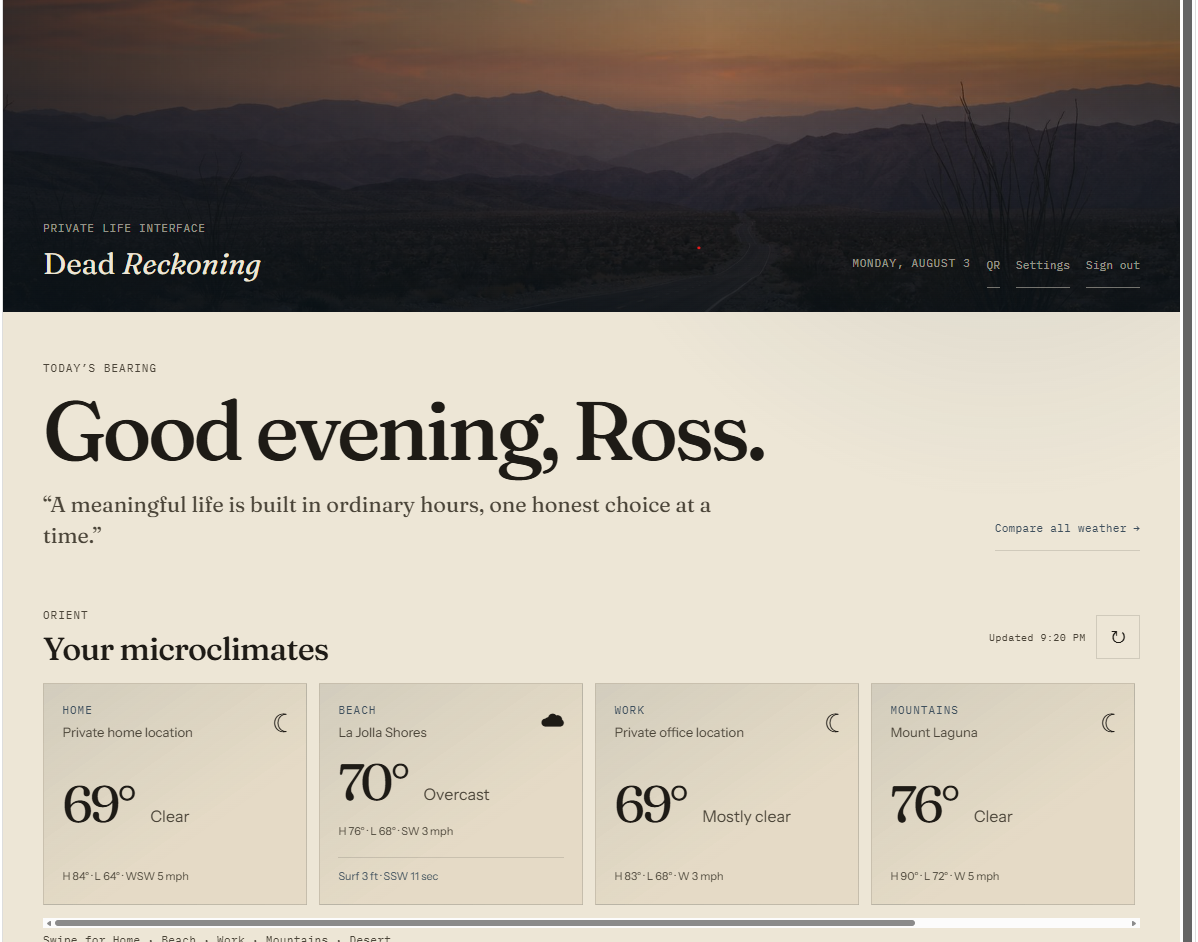
A private Today view brings together local microclimates, marine conditions, tides, a read-only agenda, and the commitments that deserve attention now.
Build notes, photographs, locations, field logs, captions, and project progress can be recorded quickly, edited later, and queued when the connection disappears.
An AI-supported workflow can read the day’s calendar and current tasks, suggest a small number of useful actions, and leave every consequential choice with Ross.
Dead Reckoning decides what becomes a Field Note, Build Log entry, featured image, project update, or public artifact—and what remains part of the private record.
Structured records, original media, archive health, and portable exports keep the story independent of a social network, a temporary format, or a company’s business model.
04 / The private surface
The Today view turns a complex backbone into a calm daily instrument.
Weather answers whether the beach, mountains, desert, home, or work environment is calling. Calendar context shows what is already spoken for. Coach’s Corner offers up to five AI-supported suggestions. Ross chooses which three become required. Capture and Library keep today connected to the long view.
Conditions, commitments, and the few things that matter.
Protect an hour for the project already in motion.
Use the cooler window for time outside.
Capture one detail the future record will need.
AI suggested · chosen by you
Photos, places, progress, and the things that keep earning a place.
Illustrative case-study view · personal records and private locations omitted
05 / The build
The architecture separates private authority from public presentation.
Astro and Vercel serve the private application and public portfolio. Supabase holds structured records and original media. Weather services provide terrestrial and marine context. Google Calendar contributes view-only commitments. A permissioned AI connection reads limited daily context and returns optional suggestions without automatically deciding what becomes required.
The public case study documents the product idea and system boundaries without exposing credentials, personal locations, schedules, prompts, or archive records.
06 / The future
The future is not more posting. It is deeper continuity between memory, context, choice, and identity.
As the record grows, Dead Reckoning can become better at returning the right memory, noticing the right pattern, and asking the right question. The product succeeds if it helps Ross live more deliberately today while giving his future self an honest way back into the life.
Connect moments across years so places, people, projects, seasons, and recurring choices become visible as a life—not isolated posts.
Give the coach enough longitudinal context to notice patterns, recall intentions, and offer timely suggestions without taking agency away from the person living the day.
Strengthen exports, media recovery, and durable formats so the archive can outlast any host, interface, model, or commercial platform.

Private system · Public case study
Dead Reckoning is the hidden backbone beneath rossrogers.us—and the long record behind a life well lived.
Back to the sandbox